
From the Lesson Tee · Lachlan Robinson
The Tree Drill: Letting the Environment Teach You
A story from an old school golf coach

Old school coaching that stacks up with modern sport science
Sometimes the best way to change your swing is to stop thinking about your swing…
Harvey Penick, for those of you that don't know of him, is one of golf's most famous coaches. He has an endless supply of stories from his career, but I wanted to share one in particular with you.
As the story goes, a student arrived for a lesson and hit a few shots. Harvey noticed the student's high ball flight. Exceptionally high. As he looked into it, he noticed the classic scooping action seen among many amateur golfers. What Harvey did next was ahead of his time.
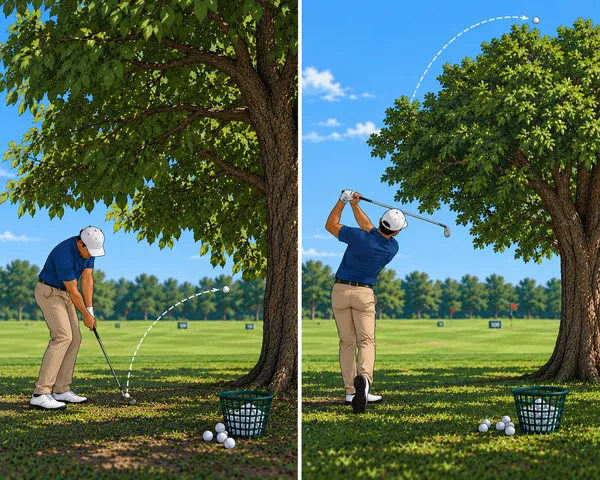
He picked up the bucket of balls, walked over to the nearest tree and told his student to hit from there, with a simple challenge: work out how to hit the ball without it touching the branches.
Then he walked away.
Around an hour later he came back, and the student had started to work it out.
No technical advice. No swing thoughts. Just a created environment, and a problem that needed solving.
Why this matters
There's a lot of modern skill acquisition theory hidden within this simple story.
Harvey didn't know the science of it, but he had discovered constraints-based learning. The branches were in the way of the student's normal shot.
This created an external focus. Rather than telling the student what to do with their hands or body, the focus was on where the ball needed to go.
From this, the process of self-organisation can take place. Through experimentation, making mistakes and trying new things, they could gradually discover the movement that works for them and produces the required result.
Learning through discovery
Our brains are powerful, but they work best in a creative sense. We can discover the technique we want simply by changing the problem in front of us and being open to discovery.
It doesn't necessarily have to be with a constraint like a tree either.
If you're just like Harvey's student, hitting the ball too high, simply ask yourself:
“How low can I hit it?”
And begin to experiment.
Enjoy practising, muck around discovering the different ways you can achieve this. Over time you will learn what it is that YOU have to do to create the shots you want.
Technique still matters of course, and understanding movement patterns can guide you to better results. But it doesn't always need to be consciously manufactured.
When you discover the solution yourself, rather than simply being told what to do, you will retain it and be able to transfer these new skills to the golf course with more ease.
Pro tip: This can be done for any element in golf. Change the task, and spend some time in discovery mode, letting your swing work out the solution.
Your drill for the week
Assess your normal ball flight.
Then create an environment that requires the exact opposite.
- Hit it too high? Let's see how low you can go.
- Curve it too much right? Let's try to curve it to the left.
Don't worry about immediately getting it right. It can take time for your brain to adapt. Experiment, make mistakes and be open to discovering new ways to complete the task.
Not sure what constraint or challenge would work for your golf swing? Book a lesson and we can create one that gets you learning, rather than just thinking about technique.
See you on the course,
Lachlan